


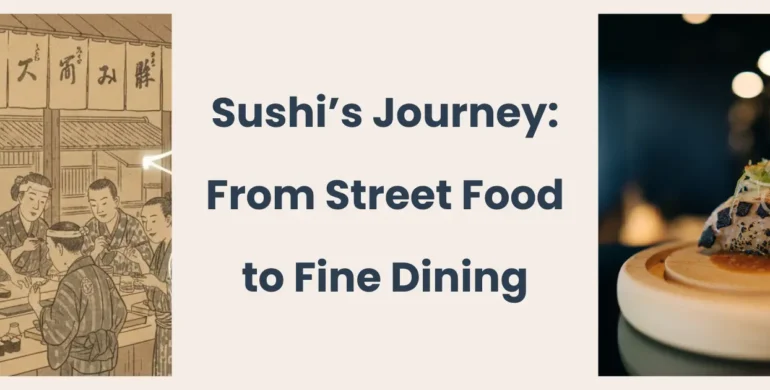
From Edo to Instagram: How Sushi Transformed and Became Luxury
From Edo to Instagram: How Sushi Transformed and Became Luxury
"In my grandfather's time, sushi was what you grabbed between jobs at the fish market. Now my children photograph it before they eat it."
— Third-generation Tokyo sushi chefSushi started as fast food for Tokyo dockworkers. Today, a single piece of otoro can cost $50. How did we get here? The story involves post-war America, overfishing, Instagram, and the commodification of scarcity. This is sushi's transformation.
In our first blog, we revealed that sushi means vinegared rice, not raw fish. In Blog 2, we explored why that rice takes decades to master. In Blog 3, we discovered sushi's traditional diversity—cooked, cured, and vegetarian items that have been part of the craft for centuries.
Now, in this final installment, we're exploring how sushi evolved from affordable street food into a global phenomenon and luxury economy. How the California Roll changed everything. Why bluefin tuna costs what it costs. And what you're really paying for when you order $300 omakase versus $15 rolls.
Where Sushi Began: The Edo Period Foundation
To understand how dramatic sushi's transformation has been, we need to start at the beginning—or at least, at the beginning of what we recognize as modern sushi.
The Birth of Nigiri: Fast Food for Workers
In the early 1800s, during the Edo period (1603-1868), Tokyo (then called Edo) was a bustling port city full of fish markets and dockworkers. A sushi chef named Hanaya Yohei had an innovation: instead of the traditional fermented sushi that took days or weeks to prepare, why not serve fresh fish on vinegared rice immediately?
The original nigiri was street food—literally sold from stalls on street corners. Workers would stop by, eat 2-3 pieces standing up, and get back to their jobs. It was fast, affordable, filling, and convenient. The portions were larger than today's nigiri (meant to be eaten in 2-3 bites), and the rice was often pressed into wooden molds for speed.
This was sushi as convenience food, not luxury dining. The fish was preserved (cured, cooked, or marinated) because refrigeration didn't exist. Freshly caught fish was quickly treated to extend its shelf life—this is why traditional Edomae sushi includes so many cured and cooked items.
What Edo-Period Sushi Actually Was
Fast: Made to order in minutes, not hours
Affordable: Priced for working-class people, not nobility
Portable: Eaten standing or walking, no formal dining
Preserved: Fish treated with salt, vinegar, or cooking—raw fish was rare
Substantial: Larger pieces meant to satisfy hungry workers
By the late 1800s, sushi had evolved into a more refined form with smaller pieces, but it remained accessible. Sushi restaurants (still fairly casual) began appearing, but the fundamental nature remained: this was food for regular people, not an exclusive luxury.

The Western Journey: How Sushi Crossed the Pacific
Sushi remained largely a Japanese phenomenon until the mid-20th century. Then came World War II, American occupation of Japan, and a slow cultural exchange that would eventually transform sushi forever.
Post-WWII: The Slow Introduction (1950s-1960s)
After WWII, American soldiers stationed in Japan were exposed to Japanese cuisine. Some developed a taste for it. Japanese immigrants in California, particularly in Los Angeles' Little Tokyo, began opening sushi restaurants in the 1950s and 60s—primarily serving the Japanese-American community.
But there was a significant barrier: Americans were deeply resistant to eating raw fish.
Cultural context matters: In 1960s America, raw fish was associated with poverty, desperation, or illness. "Fresh fish" meant cooked fish. The idea of paying money to eat raw fish seemed absurd, even dangerous, to most Americans.
Early sushi restaurants in America navigated this by emphasizing cooked items (tempura, teriyaki) and slowly introducing sushi to adventurous diners. Marketing positioned it as exotic, sophisticated, and daring—"Are you brave enough to try raw fish?"
The California Roll Revolution (1960s-1970s): The Gateway
Then came an innovation that changed everything: the California Roll.
The Genius of the California Roll
The California Roll (invented in Los Angeles, though the exact origin is disputed) made several clever adaptations:
1. Rice on the outside: Hid the nori (seaweed), which Americans found off-putting
2. Familiar ingredients: Imitation crab (or real crab), avocado, cucumber—nothing raw, nothing "scary"
3. Mild flavors: Creamy avocado, sweet crab—appealing to American palates
4. Approachable presentation: Looked less foreign, more appetizing to Western eyes
The California Roll was a gateway drug for sushi. It allowed Americans to try "sushi" without confronting raw fish. Once comfortable with the format, many diners gradually progressed to traditional items.
In Japan, the California Roll was (and still is) seen as bizarre, even laughable—rice on the outside? Avocado? Imitation crab? This isn't sushi, it's... something else.
But commercially, it was genius. It opened the American market.

The 1980s Boom: Sushi as Status Symbol
By the 1980s, sushi had become fashionable in major American cities—New York, Los Angeles, San Francisco. It shifted from "exotic curiosity" to "status symbol."
Business executives held meetings at sushi restaurants. Celebrities were photographed eating sushi. Food magazines declared it the cuisine of the sophisticated and health-conscious. Sushi represented cosmopolitanism, adventurousness, refined taste—and yes, wealth.
This was the beginning of sushi as aspirational dining. Prices rose accordingly. What had been affordable street food in Tokyo was now positioned as upscale dining in New York.
The irony: As sushi became expensive in the West, it helped elevate its status back in Japan. High-end sushi restaurants in Tokyo began emphasizing their craft, tradition, and premium ingredients—partly in response to Western interest and partly to differentiate themselves from the flood of cheaper conveyor-belt sushi chains emerging in Japan.
What Changed in Western Sushi
As sushi adapted to Western markets, several key changes occurred:
How Western Sushi Diverged from Tradition
- Size increased: American portions grew larger—harder to eat in one bite, meant to feel more substantial
- New ingredients emerged: Cream cheese (Philadelphia Roll), spicy mayo, eel sauce drizzles, tempura coating, jalapeños, mango, fried elements—ingredients that would never appear in traditional Japanese sushi
- Presentation became theatrical: Towers, boats, elaborate plating, sauces painted in patterns—visual drama trumped traditional simplicity
- The "raw fish" emphasis: Ironically, Western sushi emphasized raw fish MORE than traditional Japanese sushi did, even though Americans were initially afraid of it. Once people got comfortable, raw tuna and salmon became the stars, overshadowing traditional cooked and cured items
- All-you-can-eat culture: Buffet-style sushi restaurants emerged, emphasizing volume over quality—something that would horrify traditional sushi chefs
Is Western sushi "wrong"? That's the wrong question. It's different—an adaptation to local tastes, ingredients, and expectations. Fusion cuisine has always existed. The California Roll isn't less valid than traditional nigiri; it's just a different expression that emerged from different cultural context.
But understanding the difference helps you appreciate both for what they are.
The Instagram Era: Visual Culture Meets Food (2010s-Present)
Then came social media, and sushi transformed again.
The Instagrammable Imperative
Instagram, launched in 2010, fundamentally changed how restaurants (especially visually appealing ones like sushi) approached presentation. Suddenly, how food looked in photos mattered as much as how it tasted.
What Instagram Changed About Sushi
Color became currency: Vibrant, multicolored rolls performed better on social media than simple, elegant nigiri. Restaurants responded by creating visually dramatic items—rainbow rolls, rolls with multiple sauces drizzled in patterns, torched items with char marks.
Size and spectacle: Oversized rolls, sushi "burritos," sushi "donuts," sushi towers—novelty and visual impact drove engagement
The "wow factor": Restaurants competed to create shareable moments—flaming presentation, dry ice effects, gold leaf garnishes
Traditional suffered (initially): Simple, elegant nigiri didn't photograph as well as elaborate fusion rolls. This created a tension between visual appeal and traditional craft
The documentary "Jiro Dreams of Sushi" (2011) had an interesting counterbalancing effect—it created a appreciation for minimalist, traditional, craft-focused sushi. Suddenly, aspiring foodies wanted the opposite of Instagram excess: they wanted the real thing, the traditional experience, the omakase counter with a master chef.
This created a split in the sushi market: theatrical fusion for the Instagram crowd, and refined traditional for the connoisseur crowd. Both are viable. Both have their place. Neither is inherently better.
The Luxury Economy: How Scarcity Created $50 Otoro
Now let's address the elephant in the room: Why does some sushi cost $50 per piece while other sushi costs $2?
The answer involves overfishing, regulation, media attention, and the commodification of scarcity.
The Bluefin Tuna Story: From Abundant to Endangered
In the 1970s-80s, as sushi boomed globally, demand for certain fish—especially bluefin tuna—skyrocketed. Bluefin, previously undervalued in Japan (it was considered too fatty and strong-flavored), suddenly became desirable as tastes changed and wealthy consumers sought premium items.
In the 1980s-2000s, industrial fishing operations targeted bluefin tuna aggressively. Populations plummeted—some species by as much as 90%. The fish that had been abundant for centuries was suddenly endangered.
International organizations (ICCAT - International Commission for the Conservation of Atlantic Tunas) implemented quotas and regulations in the 2000s-2010s. Fishing limits were established. Seasons were restricted. Certain species received protection.
Scarcity drove prices up dramatically.
The Auction Spectacle: Media Creates Value
The Tsukiji fish market in Tokyo (now moved to Toyosu) became famous for its early-morning tuna auctions. Media coverage turned these auctions into spectacle:
Record prices made headlines: In 2013, a 489-pound bluefin tuna sold for $1.76 million. In 2019, a 612-pound bluefin sold for $3.1 million. These weren't just transactions—they were publicity stunts by wealthy restaurant owners seeking media attention.
But the media coverage had real effects: it established bluefin tuna, especially otoro, as the ultimate luxury item. If someone paid $3 million for a fish, clearly the best cuts must be extraordinarily valuable, right?
This became a self-fulfilling cycle: publicity drove demand, demand drove prices, high prices justified the publicity.

Understanding Bluefin Anatomy: Why Otoro Costs What It Costs
Let's break down the economics of a bluefin tuna to understand why otoro commands premium prices:
The Bluefin Breakdown
Akami (赤身) - Lean Red Meat:
• Location: Back and sides of the fish
• Characteristics: Deep red color, lean, clean iron-rich flavor
• Abundance: Most of the fish by weight (~60-70%)
• Price: Most affordable of the three cuts
• Quality: Excellent, but not rare
Chutoro (中トロ) - Medium Fatty Belly:
• Location: Lower belly area, between akami and otoro
• Characteristics: Pink-red with visible white fat marbling
• Abundance: Moderate (~15-20% of fish)
• Price: Mid-tier premium
• Flavor: Balance of clean tuna flavor and rich fat
Otoro (大トロ) - Supreme Fatty Belly:
• Location: Underside of belly, specific small section
• Characteristics: Intense marbling, almost white with pink, melts at body temperature
• Abundance: Only ~5% of the fish by weight
• Price: Premium tier - $30-100+ per piece depending on quality and location
• The reality: A 500-pound bluefin yields only 10-15 pounds of otoro
Why Otoro Costs $50+ Per Piece
1. Extreme scarcity: Only 5% of an already-regulated, quota-limited fish. When you're serving otoro, you're serving the rarest part of a rare fish.
2. Auction competition: Top restaurants compete for the best fish. Premium bluefin can cost $10,000-50,000+ at auction. That cost gets distributed across relatively few premium pieces.
3. Grading systems: Bluefin is graded on fat content, color, texture, and origin. Top-grade otoro from specific regions (Oma, Hokkaido) commands even higher prices.
4. Quotas and regulations: Limited fishing seasons and catch limits mean supply is artificially constrained (for good environmental reasons), driving prices higher.
5. Demand exceeds supply: Globally, wealthy diners want to experience "the best." When everyone wants the same 5% of the fish, prices skyrocket.
6. Restaurant economics: High-end restaurants need to cover rent, staff, sourcing relationships, waste (not every part of the fish is usable), and maintain their reputation. These costs are built into luxury items.

Is otoro "worth" $50? That's subjective. What you're paying for isn't just the fish—it's the entire system: the sourcing relationships, the market competition, the scarcity, the skill to prepare it properly, and yes, the cultural cachet of eating something rare and luxurious.
Personal take: Otoro is delicious—rich, buttery, complex. But diminishing returns exist. The difference between good akami and great otoro is significant. The difference between great otoro and the absolute most expensive otoro? Much smaller. At a certain point, you're paying for bragging rights as much as flavor.
Other Luxury Items: Beyond Bluefin
Otoro gets the headlines, but the luxury sushi economy includes several other premium items worth understanding.
Uni (Sea Urchin): The Polarizing Delicacy
Uni is one of those items people either love obsessively or can't stand. There's rarely middle ground.

Why Uni Is Expensive
Labor-intensive harvesting: Sea urchins are harvested by hand by divers. It's dangerous, time-consuming work in cold waters.
Minimal yield: Only about 20% of a sea urchin is edible roe (the uni). The rest is shell, organs, and liquid.
Extremely short shelf life: Fresh uni degrades quickly—hours to 2-3 days maximum. This creates complex logistics and limits supply.
Seasonal peaks: Quality varies dramatically by season. Peak season uni (usually winter/spring depending on region) commands premium prices.
Regional prestige: Hokkaido uni is considered the gold standard. Santa Barbara uni has developed a following. Chilean uni is more affordable but different in flavor. Origin matters, and top regions charge accordingly.
Understanding Uni Quality
Color indicators:
• Bright orange or golden = fresh, high quality
• Brown or dull = oxidized, old, poor quality
Texture:
• Firm lobes that hold shape = fresh
• Mushy or falling apart = old or poor handling
Flavor profile:
• Creamy, sweet-briny, oceanic = good uni
• Bitter, metallic, or fishy = bad uni or personal preference
Varieties:
• Bafun uni (馬糞雲丹): Smaller, darker orange, more intense flavor
• Murasaki uni (紫雲丹): Larger lobes, golden color, sweeter, creamier
The acquired taste factor: Uni's creamy, briny, intensely oceanic flavor isn't for everyone. And that's completely fine. Not liking uni doesn't mean you don't appreciate sushi—it means you know what you like.
Other Premium Items Worth Knowing
The Luxury Sushi Roster
Chu-toro Hamachi (Yellowtail Belly):
Similar concept to tuna belly—the fattiest part of yellowtail. Rich, buttery, winter peak season. Not as famous as otoro but equally delicious and often more affordable.
Kinmedai (Golden Eye Snapper):
Deep-water fish from 200-800 meters depth. Limited catch, prized texture, beautiful red-gold color. Often served aburi (lightly torched). Premium pricing reflects scarcity and labor of deep-sea fishing.
Nodoguro (Blackthroat Seaperch):
Called "the toro of white fish" for its incredibly high fat content. Regional specialty from the Sea of Japan. Seasonal availability and limited supply make it expensive when available.
Seasonal Rarities:
• Shirako (Cod Milt): Winter delicacy, creamy texture, acquired taste
• Hatsu-gatsuo (First Bonito of Spring): Cultural significance drives premium for first catch
• Iwashi (Sardine) at peak: When fatty and rich (summer), can be surprisingly premium
Ikura (Salmon Roe):
Graded by size, color, firmness, and how cleanly the eggs pop. Top-grade ikura with perfect "pop and burst" commands premium prices. Seasonal (fall/winter) availability affects pricing.
The Omakase Premium: Why $300+ Tasting Menus Exist
Let's address the elephant in the room: Why do some sushi restaurants charge $200, $300, even $500+ for omakase?
Omakase (お任せ) means "I leave it up to you"—you're trusting the chef to compose your meal based on what's best that day, their expertise, and your preferences (if communicated).

What You're Actually Paying For
The True Cost of High-End Omakase
1. Sourcing Relationships and First Pick
Top sushi restaurants have relationships with specific fish markets, individual fishermen, and importers. They get first pick of the daily catch—literally the best fish available. This access costs money: higher bids at auction, deposits, guaranteed purchases regardless of what arrives.
2. Premium Ingredients Beyond Fish
• Top-grade sushi rice (Koshihikari from specific prefectures)
• Real wasabi, freshly grated (not horseradish paste)
• Aged soy sauce or house-made nikiri
• Imported nori from specific regions
• Every element is premium, not just the fish
3. Decades of Training and Expertise
You're paying for a chef who spent years (often 10-15 years) apprenticing, learning knife skills, fish aging techniques, rice preparation, and the intuition to know when fish is at peak ripeness. This expertise can't be replicated quickly or cheaply.
4. Limited Seating and Personalized Attention
High-end omakase restaurants typically seat 8-12 people maximum. The chef interacts directly with each guest, paces the meal individually, adjusts based on preferences. This intimacy and attention is expensive—fewer customers means higher per-person costs.
5. The Experience and Atmosphere
Premium location, hinoki wood counters imported from Japan, carefully curated sake selection, service staff, ambiance. You're paying for the complete experience, not just food.
6. Waste and Risk
Not every part of premium fish is usable at the highest level. High-end restaurants discard more than budget places do. They also take risks buying whole fish at auction—if quality isn't perfect, they lose money.
The spectrum exists for a reason: $50 sushi can be excellent—fresh fish, good technique, fair pricing. $300 omakase offers something different: access to ingredients most restaurants can't source, expertise that takes decades to develop, and an intimate experience with a master craftsperson. Neither is inherently "better"—they serve different purposes and audiences.
Diminishing Returns and Personal Value
Here's an honest truth: the difference between $50 sushi and $150 sushi is significant. The difference between $300 and $500? Much smaller.
At a certain point, you're paying for:
What the Highest Prices Buy
- Exclusivity: Limited seats, hard-to-book reservations, bragging rights
- Provenance: Fish from specific legendary suppliers or regions
- The chef's reputation: Eating at a Michelin-starred restaurant or with a famous chef
- Micro-improvements: The difference between great and absolutely perfect
Whether those things are worth the premium is entirely personal. For some, the experience of eating at Sukiyabashi Jiro or a similar legendary restaurant is a once-in-a-lifetime moment worth $500. For others, excellent $80 omakase at a respected local restaurant provides 90% of the experience at a fraction of the cost.
Know what you're paying for, and decide if it aligns with your values and budget.
Sustainability: The Uncomfortable Truth
We can't discuss luxury sushi without addressing sustainability. The bluefin tuna story isn't just about economics—it's about environmental crisis.
The Bluefin Question
The Current State of Bluefin
Pacific Bluefin: Severely depleted, population at ~3-4% of historical levels. Some recovery due to recent quotas, but still vulnerable.
Atlantic Bluefin: Better recovery than Pacific, but still overfished and heavily regulated. Quotas have helped populations stabilize.
Southern Bluefin: Critically endangered, tightly regulated, expensive when available.
Should you eat bluefin tuna? This is a personal decision, but here's the context:
Making Informed Choices
The case against: Even with quotas, demand continues driving prices up, which incentivizes illegal fishing and quota violations. Every purchase signals continued demand for a vulnerable species.
The case for (with caveats): Legal, quota-regulated bluefin from well-managed fisheries allows the industry to continue while populations recover. Complete boycott might devastate fishing communities and eliminate incentive for proper management.
The middle ground: Eat bluefin rarely, as a special occasion item. Ask restaurants about sourcing. Support restaurants that are transparent about sustainability.
Better Alternatives
Sustainable Luxury Options
- Bigeye Tuna: Similar flavor profile to bluefin, more sustainable populations
- Yellowfin Tuna: Abundant, well-managed in many regions, excellent quality
- Farmed Salmon: When done responsibly (especially land-based operations), significantly reduces wild fish pressure
- Underutilized Species: Many delicious fish are underappreciated—mackerel, sardines, certain snapper varieties
- Seasonal Eating: Choosing fish at their peak season means better flavor AND better environmental timing
At SushiMen, we're mindful of sourcing. We offer premium items when available, but we're transparent about origins and encourage customers to explore the full range of traditional sushi, not just the most expensive items.
Modern Context: Where We Are Now
So where does all this leave us in 2025?
The Current Sushi Landscape
Today's sushi world is beautifully diverse and sometimes contradictory:
The Spectrum of Modern Sushi
$10-15 Sushi: Conveyor belt chains, grocery store sushi, fast-casual spots. Variable quality, convenient, accessible. Not "bad," just optimized for volume and price point.
$30-60 Sushi: Solid neighborhood restaurants, respectable fish quality, trained chefs, proper technique. This is where most people will find their best value-to-quality ratio.
$80-150 Omakase: Excellent restaurants with premium ingredients, skilled chefs, thoughtful sourcing. Often the sweet spot for serious sushi enthusiasts.
$200-300 Omakase: Top-tier restaurants, exceptional ingredients, master chefs, intimate experience. Noticeable improvement over mid-tier, worth it for special occasions.
$300-500+ Omakase: Legendary restaurants, famous chefs, ultra-premium sourcing, exclusivity. Diminishing returns kick in, but the experience can be memorable.
What's Different from Edo Period
Then vs. Now
Then (1800s):
- Street food for workers
- Affordable and accessible
- Limited by local catch
- Preservation-focused (pre-refrigeration)
- Cultural food, not exotic
Now (2025):
- Ranges from fast food to luxury fine dining
- $2 to $100+ per piece
- Global ingredient access
- Refrigeration and flash-freezing enable raw fish safety
- International phenomenon, cultural fusion
- Instagram influence on presentation
- Sustainability awareness and regulations
What Remains the Same
Despite all the changes, some fundamentals haven't shifted:
The Unchanging Core:
• Rice is still the soul—master chefs still spend years perfecting it
• Technique still takes decades to learn
• Balance is still the philosophy—flavor, texture, temperature
• Respect for ingredients still defines quality
• Seasonality still matters to those who care about craft
• The best sushi still requires patience, precision, and deep knowledge
What This Means for You: The Informed Diner
You've now completed the Sushi Foundation Series. You understand:
What You've Learned Across All 4 Blogs
Blog 1: Sushi means vinegared rice, not raw fish. The rice is the soul, the fish is the accent. Traditional sushi has always included cooked, cured, and vegetarian options.
Blog 2: Sushi rice takes 3 years to learn and a lifetime to master. Daily variables, vinegar blends, and rice varieties all matter. Even masters with 40 years of experience say they're still learning.
Blog 3: Traditional sushi offers incredible diversity—tamago, unagi, ebi, tako, cured fish, aburi techniques, vegetarian classics. These aren't alternatives; they're essentials. Your preferences are valid.
Blog 4: Sushi transformed from Tokyo street food to global luxury. Westernization changed it, scarcity created premium pricing, and modern context offers both tradition and fusion. Understanding what you're paying for helps you make informed choices.
How to Use This Knowledge
Being an Informed Sushi Diner
Evaluate restaurants by their rice: If the rice is poorly seasoned, too cold, or compressed, the restaurant doesn't understand fundamentals—regardless of how expensive their toro is.
Try the full spectrum: Don't limit yourself to raw fish or the most expensive items. Traditional cooked items showcase a chef's skill just as much as premium sashimi.
Understand what you're paying for: Premium prices should reflect premium ingredients, skilled preparation, and thoughtful sourcing—not just exclusivity or hype.
Ask questions: Where is the fish from? How is it prepared? Is it sustainable? Good restaurants are transparent and happy to explain.
Know your values: If sustainability matters to you, make choices that reflect that. If experiencing legendary restaurants matters, save for it and go. If excellent mid-tier sushi satisfies you, enjoy it without FOMO.
Respect the craft: Whether you're eating $15 sushi or $300 omakase, appreciate the work that went into it—the years of training, the daily adjustments, the sourcing, the technique.
The Future of Sushi
Where is sushi heading? A few trends worth watching:
Emerging Directions
Sustainability-focused chefs: Younger generation prioritizing responsible sourcing, underutilized species, seasonal eating
Technology integration: Flash-freezing techniques improving raw fish safety, farming innovations reducing wild fish pressure
Regional fusion: Local ingredients meeting traditional technique—not just "American fusion" but thoughtful regional expressions worldwide
Transparency: More restaurants disclosing sourcing, methods, and sustainability practices
Democratization: Quality sushi becoming more accessible through cloud kitchens (like SushiMen), better supply chains, and education
The challenge is balancing tradition with innovation, craft with accessibility, and demand with sustainability. The restaurants that navigate this well will thrive. Those that chase trends without respecting fundamentals won't last.
"Sushi's journey from Edo to Instagram isn't about better or worse. It's about adaptation, evolution, and understanding what we value. The best sushi isn't always the most expensive. It's the sushi made with care, eaten with awareness, and appreciated for what it truly is."
— The essence of informed sushi appreciationYour Sushi Journey: What Comes Next
You now understand sushi more deeply than 99% of people who eat it regularly. You know the history, the craft, the economics, and the transformation.
So what do you do with this knowledge?
Order sushi this weekend. Pay attention to the rice—is it properly seasoned, slightly warm, light and airy? Try something you've never had before—maybe tamago to test the chef's fundamentals, or unagi to experience traditional cooked sushi, or a simple kappa maki to appreciate how refreshing vegetables can be.
If you order from SushiMen, know that every element has been considered: the rice we've spent years perfecting, the fish we source thoughtfully, the packaging we've engineered to preserve temperature, the traditional items we honor alongside modern favorites.
Whether you order from us or anywhere else, taste with intention. Notice the details. Appreciate the craft. Understand what you're experiencing.
Sushi is not just food. It's a conversation between history and modernity, between tradition and innovation, between the chef's expertise and your palate.
Now you're equipped to participate in that conversation.
Experience Sushi with New Understanding
You've completed the Sushi Foundation Series. Now taste the difference that knowledge makes. From rice perfected through years of daily adjustment, to traditional diversity honoring centuries of craft, to transparent sourcing and thoughtful preparation—experience sushi the way it was meant to be appreciated.
Order This Weekend Our Story & PhilosophyThank you for reading the complete Sushi Foundation Series. We hope it changes how you experience sushi forever.
The Sushi Foundation Series - Complete
- Part 1: What Is Sushi? It's Not What You Think
- Part 2: The Art of Sushi Rice: Why Master Chefs Are Still Learning
- Part 3: Beyond Raw Fish: The Traditional Diversity of Sushi
- Part 4: From Edo to Instagram - Sushi's Transformation (You Are Here)
Congratulations on completing the series! Share it with someone who loves sushi.
🍣 From Edo to your table. From street food to craft. Eat well, eat mindfully, eat with understanding.
There are no comments


